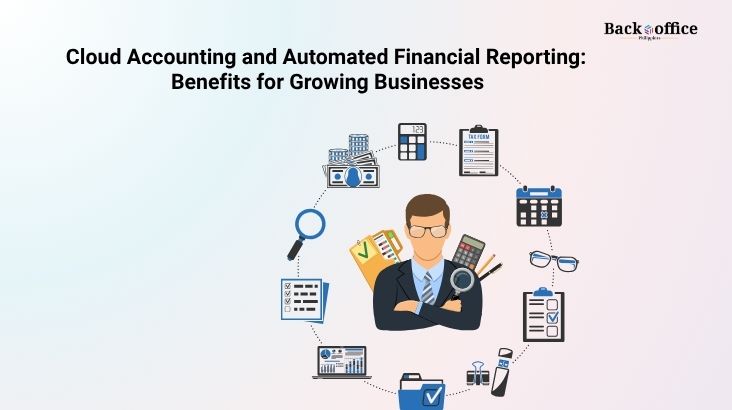
Cloud Accounting and Automated Financial Reporting: Benefits for Growing Businesses
Cloud Accounting and Automated Financial Reporting: Benefits for Growing Businesses Growing businesses need accurate financial information to make informed decisions, manage expenses, and plan for the future. However, as transactions increase and operations become more complex, traditional accounting methods can make financial management time consuming and difficult to maintain. Manual data entry, delayed reports, and spreadsheet errors can affect a company’s ability to understand its financial position. Cloud accounting and automated financial reporting offer a more efficient approach. By combining cloud based accounting software with automated data processing and reporting workflows, businesses can access up to date financial information, reduce repetitive tasks, and improve visibility into their operations. For companies looking to scale efficiently, these technologies can also complement outsourced accounting services and professional back office support. What Is Cloud Accounting? Cloud accounting is a method of managing financial records through accounting software hosted online. Instead of relying entirely on desktop applications or locally stored files, authorized users can access financial information through an internet connection. Cloud accounting software helps businesses manage invoices, expenses, bank transactions, accounts payable, accounts receivable, and financial statements from a centralized platform. Some common capabilities include: These features make cloud accounting useful for growing businesses that need flexible financial management without depending on a single office location. What Is Automated Financial Reporting? Automated financial reporting uses software and predefined workflows to collect, organize, process, and present financial data. Instead of manually compiling information from multiple spreadsheets and systems, businesses can automate many routine reporting activities. Depending on the software and workflow, automated financial reporting can generate reports such as: Automation can reduce repetitive work and help finance teams prepare reports more consistently. However, the quality of the output still depends on accurate source data, appropriate accounting rules, and proper review. Key Benefits of Cloud Accounting and Automated Financial Reporting 1. Access Financial Information from Anywhere One of the main advantages of cloud accounting is the ability to access financial information remotely. Business owners, accountants, and authorized team members can review records without being limited to a particular office computer. This flexibility is particularly useful for companies with remote employees, multiple branches, or outsourced finance teams. Everyone with the appropriate permissions can work from the same system, reducing the need to exchange multiple versions of spreadsheets. With cloud based accounting software, management can review financial performance, monitor outstanding invoices, and track expenses more conveniently. 2. Reduce Manual Accounting Work Manual accounting tasks often include entering transaction details, categorizing expenses, matching bank transactions, and compiling financial reports. As transaction volumes increase, these activities can consume significant staff time. Automated financial reporting helps reduce repetitive work by transferring data between connected systems, applying predefined rules, and generating reports from available financial records. Automation can help finance teams: Human review remains important, especially for unusual transactions, reconciliations, adjustments, and final financial statements. 3. Improve Financial Accuracy and Consistency Accurate financial information is essential for business planning. Errors in transaction records, duplicated entries, or incorrect expense classifications can lead to misleading reports. Cloud accounting systems and automated workflows can improve consistency by applying standardized processes and reducing unnecessary manual handling. Reconciliation tools and validation checks can also help identify discrepancies that require investigation. For better results, businesses should establish clear accounting procedures, review exception reports, and regularly reconcile financial records. Working with an experienced accounting support team can further strengthen these processes by providing additional checks on data entry, transaction classification, and reporting preparation. 4. Get Faster Financial Reports Traditional reporting can require finance teams to collect data from several sources, organize spreadsheets, check calculations, and prepare summaries manually. These steps can delay access to important financial information. With automated financial reporting, businesses can schedule recurring reports and use connected data sources to generate updated summaries more efficiently. Faster reporting helps management review revenue, expenses, cash flow, and outstanding payments without waiting for every report to be compiled from scratch. It is important to distinguish between frequently updated reports and finalized financial statements. Month end adjustments, reconciliations, and approval procedures may still be necessary before financial results are considered final. 5. Improve Cash Flow Management Cash flow problems can affect businesses even when sales are growing. Delayed customer payments, rising operating costs, and poor visibility into upcoming obligations can make it difficult to plan expenses. Cloud accounting tools can help businesses monitor accounts receivable, accounts payable, and available cash. Automated reports can highlight overdue invoices, upcoming payment obligations, and changes in cash flow patterns. These insights help business owners identify potential issues earlier and take appropriate action, such as following up on unpaid invoices or reviewing planned expenditure. Better cash flow visibility is particularly valuable for growing companies that need to balance expansion costs with day to day operating expenses. 6. Support Better Business Decisions Business growth requires decisions about hiring, marketing, inventory, equipment, and expansion. Making these decisions without reliable financial information can increase uncertainty. Automated financial reporting provides structured information that helps management understand financial performance and identify areas that require attention. For example, a business can compare monthly revenue, review operating expenses, monitor profit margins, and evaluate performance against its budget. When financial information is accurate and reports are reviewed regularly, decision makers can identify trends, allocate resources more effectively, and develop realistic growth plans. 7. Strengthen Collaboration with Accounting Teams Growing businesses may rely on internal accountants, external financial consultants, or outsourced accounting providers. Cloud accounting makes collaboration easier by allowing authorized users to work with shared financial records. Instead of repeatedly emailing spreadsheets and documents, teams can access information through a common platform, subject to their assigned permissions. Businesses can also combine cloud accounting with outsourced finance and accounting services to obtain support for bookkeeping, transaction processing, account reconciliation, and financial report preparation. This approach can help companies manage increasing workloads while allowing internal teams to focus on business operations and strategic priorities. 8. Improve Financial Data Security and Control Financial information contains sensitive business details, including transaction records, supplier information, payroll data, and
Cloud Accounting and Automated Financial Reporting: Benefits for Growing Businesses Read More »